

| Office for Budget Responsibility warned the Middle East conflict will impact both global and UK economies significantly | Last month, Bank of England policymakers unanimously voted to maintain interest rates at their current level of 3.75% | Office for National Statistics figures indicate pay growth is slowest for five years and consumer confidence dipped |
Middle East conflict hits UK economy
The Office for Budget Responsibility (OBR) warned the Middle East conflict will have ‘very significant impacts on the global and UK economies’ as the Chancellor unveiled the independent forecaster’s latest economic predictions in her Spring Statement.
Rachel Reeves delivered her fiscal update to the House of Commons on 3 March with the OBR’s new figures suggesting the UK economy will expand by 1.1% this year, a downgrade from 1.4% last autumn. Growth expectations for the following two years were both nudged slightly higher.
The forecast, though, was produced before conflict in the Middle East broke out, meaning the predictions were effectively out of date before the Chancellor read them out. Indeed, analysis by the Organisation for Economic Co-operation and Development released late last month suggests the conflict will hit the UK harder than any other major economy, with the international soothsayer cutting its 2026 UK growth forecast to 0.7%, from 1.2% previously.
Gross domestic product figures published last month by the Office for National Statistics (ONS) also showed the UK economy was already in a fragile state before the Iran war began, with zero growth recorded in January. ONS described the overall picture as ‘subdued.’
Meanwhile, data from the latest S&P Global UK Purchasing Managers’ Index highlighted a more recent marked slowdown, with March’s preliminary headline growth indicator pointing to the slowest expansion in private sector output since September 2025.
S&P Global Market Intelligence’s Chief Business Economist Chris Williamson said, “The war in the Middle East has hit the UK economy in March. Output growth across manufacturing and services has slowed to a crawl as companies blamed lost business directly on the events in the Middle East, whether through heightened risk aversion among customers, surging price pressures, higher interest rates, or via travel and supply chain disruptions.”
Interest rates on hold for now
Last month, Bank of England (BoE) policymakers unanimously voted to maintain interest rates at their current level of 3.75%, adding that they stand ‘ready to act as necessary’ to ensure inflation remains on track to meet the Bank’s 2% target.
Before the outbreak of hostilities with Iran, analysts had generally expected the BoE’s Monetary Policy Committee (MPC) to sanction another rate reduction following its latest meeting which concluded on 18 March. However, with price pressures from the Middle East conflict raising the prospect of another pick-up in inflation, all nine MPC members ultimately voted to leave Bank Rate on hold.
The minutes to the meeting did show that some MPC members felt an increase in rates may be needed if the ongoing war places sustained pressure on energy prices. They also stated, though, that ‘there was a range of possibilities for how monetary policy might need to respond to different developments and risks’ and that, by the time of the committee’s next meeting in late April, more information would be available to betterassess the situation.
Speaking after announcing the interest rate decision, BoE Governor Andrew Bailey stressed that the MPC was ready to act in order to ensure inflation gets back to the Bank’s target level. Mr Bailey also cautioned against reaching any “strong conclusions” about the need to raise rates soon, adding “today we’ve given a very clear message – the right place to be is on hold.”
A week after the MPC meeting, ONS published February’s official inflation statistics which showed that the annual headline CPI rate was 3.0%, the same reading as recorded in January. Analysts’ expectations, however, are that the CPI rate will inevitably lurch upwards over the coming months as the impact of the Middle East conflict exerts pressure on prices.
Markets
After a challenging month on global markets, with the uncertainty of the Middle East conflict weighing, some positivity was evident at month end as reports surfaced that President Trump was prioritising diplomatic efforts over continued military escalation.
With the Strait of Hormuz effectively blocked over the past few weeks and just a few oil-carrying ships able to take their cargo to the rest of the world, the price of oil pushed sharply higher and continues to be volatile. At month end, the price plummeted from highs on hopes the end of the conflict may be drawing closer. Brent Crude closed March at around $104 a barrel, recording a monthly gain of over 44%.
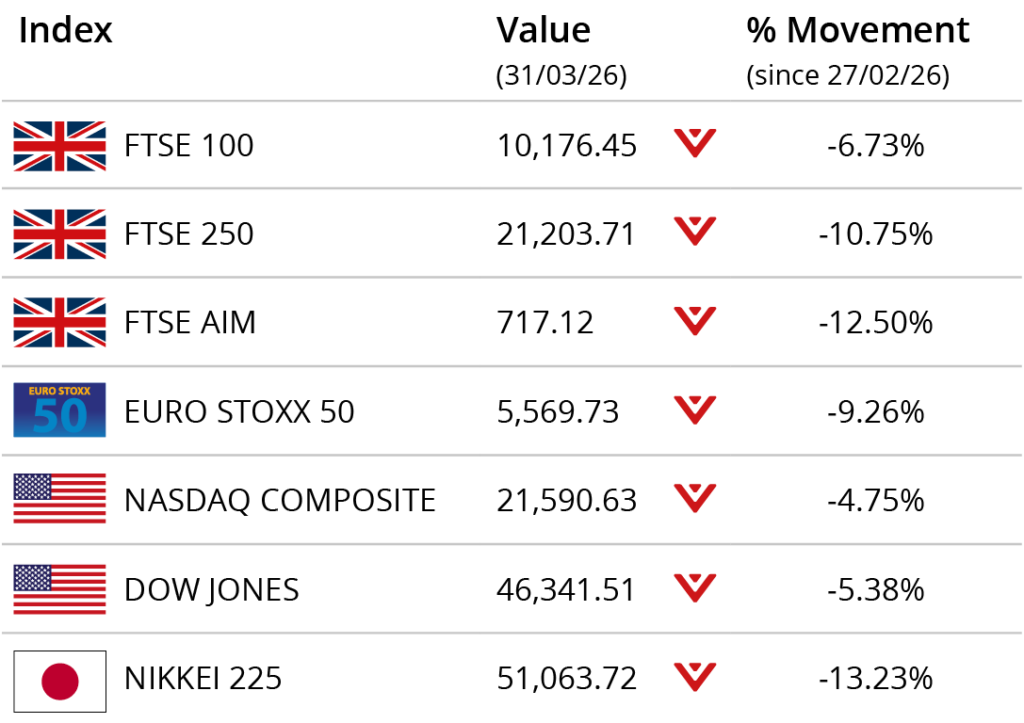
In the UK, the FTSE 100 closed the month over 6% lower on 10,176.45 and the mid-cap focused FTSE 250 ended March over 10% down on 21,203.71. The FTSE AIM recorded a loss of over 12% in March to close the month on 717.12. The Euro Stoxx 50 closed the month over 9% lower on 5,569.73. In Japan, the Nikkei 225 closed March on 51,063.72, falling over 13% in the month. In the US, the Dow Jones closed the month down over 5% on 46,341.51. The NASDAQ registered a monthly loss of 4.75% to close on 21,590.63.
On the foreign exchanges, the euro closed the month at €1.14 against sterling. The US dollar closed at $1.32 against sterling and at $1.15 against the euro.
Gold closed the month trading around $4,699 a troy ounce, a loss of over 10% in March. The short-term appeal of the precious metal was tarnished as thoughts of potential rate hikes stateside led to an uptick in real interest rates in the bond market. The price ticked higher at month end on hopes of a swift end to the conflict.
UK wage growth continues to ease
The latest batch of labour market statistics revealed that pay is now growing at its slowest rate in more than five years while other data highlights signs of stabilisation now emerging from the jobs market.
Figures released last month by ONS showed that average weekly earnings excluding bonuses rose at an annual rate of 3.8% in the three months to January 2026; this was down from 4.1% in the final quarter of 2025 and lower than a consensus forecast of 4.0% from a Reuters poll of economists. The figure also represents the smallest rate of wage growth increase since the three months to November 2020.
ONS said that other data published in the latest release showed that the number of job vacancies remained ‘broadly flat,’ while a provisional estimate for the number of payrolled employees ‘rose slightly.’ Overall, ONS noted that labour market conditions were ‘little changed at the start of this year.’
Survey data also reports more recent evidence that the jobs downturn may be easing. The monthly gauge of permanent job placements from the latest KPMG and REC survey, for instance, rose to its highest level in nearly three years, although the figure did remain slightly in contraction territory.
Consumer confidence drops on war worries
Official figures show retail sales volumes dipped in February, while survey data highlights a more recent but distinct weakening in consumer morale, driven by concerns about the economic impact of the Iran war.
Recently released ONS statistics revealed that total retail sales volumes fell by 0.4% in February. This modest decline was smaller than analysts had predicted though and followed January’s upwardly revised growth of 2.0% with retailers suggesting February’s dip partly reflected shoppers bringing forward spending to take advantage of new year sales.
Data from the latest CBI Distributive Trades Survey, however, reported a sharp decline in annual sales volumes during March with retailers saying ‘weak economic conditions’ had weighed on household spending. Retailers said they expect sales to be weak in April too.
A number of other surveys have also highlighted a drop in consumer sentiment since the start of the conflict in the Middle East. GfK’s long-running study, for example, put confidence in March at its lowest level for nearly a year as households fretted about the impact of the war. A GfK spokesperson said, “A ripple of fear is spreading. People simply do not feel the economy is robust enough to ride out the knock-on effects from the Middle East conflict.”
All details are correct at the time of writing (01 April 2026)
The value of investments can go down as well as up and you may not get back the full amount you invested. The past is not a guide to future performance and past performance may not necessarily be repeated.
It is important to take professional advice before making any decision relating to your personal finances. Information within this document is based on our current understanding and can be subject to change without notice and the accuracy and completeness of the information cannot be guaranteed. It does not provide individual tailored investment advice and is for information only. We cannot assume legal liability for any errors or omissions it might contain. No part of this document may be reproduced in any manner without prior permission.